A technical and practical guide for homeowners, designers, and wellness facility managers.
Pool steps and ladders are more than a simple accessory. They are the spot where most slip-related risk concentrates in any swimming facility. On top of that, they are one of the elements that most affects a pool’s look and usability.
Choosing the right model means balancing four factors: regulations, pool type, materials, and users. Users can include children, older adults, people with reduced mobility, and athletes. Below are the key points to keep in mind, whether you’re choosing a ladder yourself or guiding a client toward an informed decision.
Which Regulations Apply?
In Europe, safety rules for pool access points are quite specific. Here are the main references:
- UNI EN 13451-1 – Swimming pool equipment. This standard sets general safety requirements and test methods.
- UNI EN 13451-2:2020 – “Swimming pool equipment – Part 2: Additional specific safety requirements and test methods for ladders, steps and handrails.” This standard covers two distinct product families. A ladder is a vertical structure with horizontal rungs and two handrails. A step ladder (or stepped access) is an inclined structure that also features horizontal treads and handrails. Where the two standards overlap, the requirements in EN 13451-2 take precedence over the general ones in EN 13451-1.
- UNI EN 16582-1:2021 – This standard covers home pools. It sets general safety requirements and test methods for in-ground, above-ground, and partially recessed pools, including access equipment. It applies to both B2C relationships (manufacturers, installers, and retailers dealing with end consumers) and B2B relationships (between manufacturers, suppliers, and distributors).
- UNI EN 15288-1 and -2:2019 – These standards apply to public pools, covering design safety and operational safety respectively. They also address child protection and proper management of water access points in shared facilities such as hotels, wellness centers, sports venues, and residential complexes.
- UNI 10637 – This standard sets design, construction, and management requirements for water treatment systems in public pools.
For sellers and installers, the stakes are concrete. A ladder that doesn’t meet EN 13451-2 and gets installed in a public, residential, or hospitality pool exposes the operator to liability if someone gets hurt, and it can also complicate matters during inspections.
For B2C sellers, EN 16582-1 is the standard to reference when communicating a product’s safety credentials to end customers.
What Should Drive the Choice?
The right solution starts with the use case, not the catalog. Each ladder type answers a specific need.
- Existing in-ground pools on a tight budget. Here, the most common solution is the standard ladder. It attaches to the pool edge with expansion bolts and requires no masonry work, making it the natural choice for retrofitting an existing pool.
One limitation worth flagging, for yourself or for a client, is that this type doesn’t suit young children, older adults, or anyone with uncertain balance. - Hotels, spas, wellness centers, residential complexes, and other mixed-use facilities. In these settings, EN 13451-2 points to stepped access as the better solution.
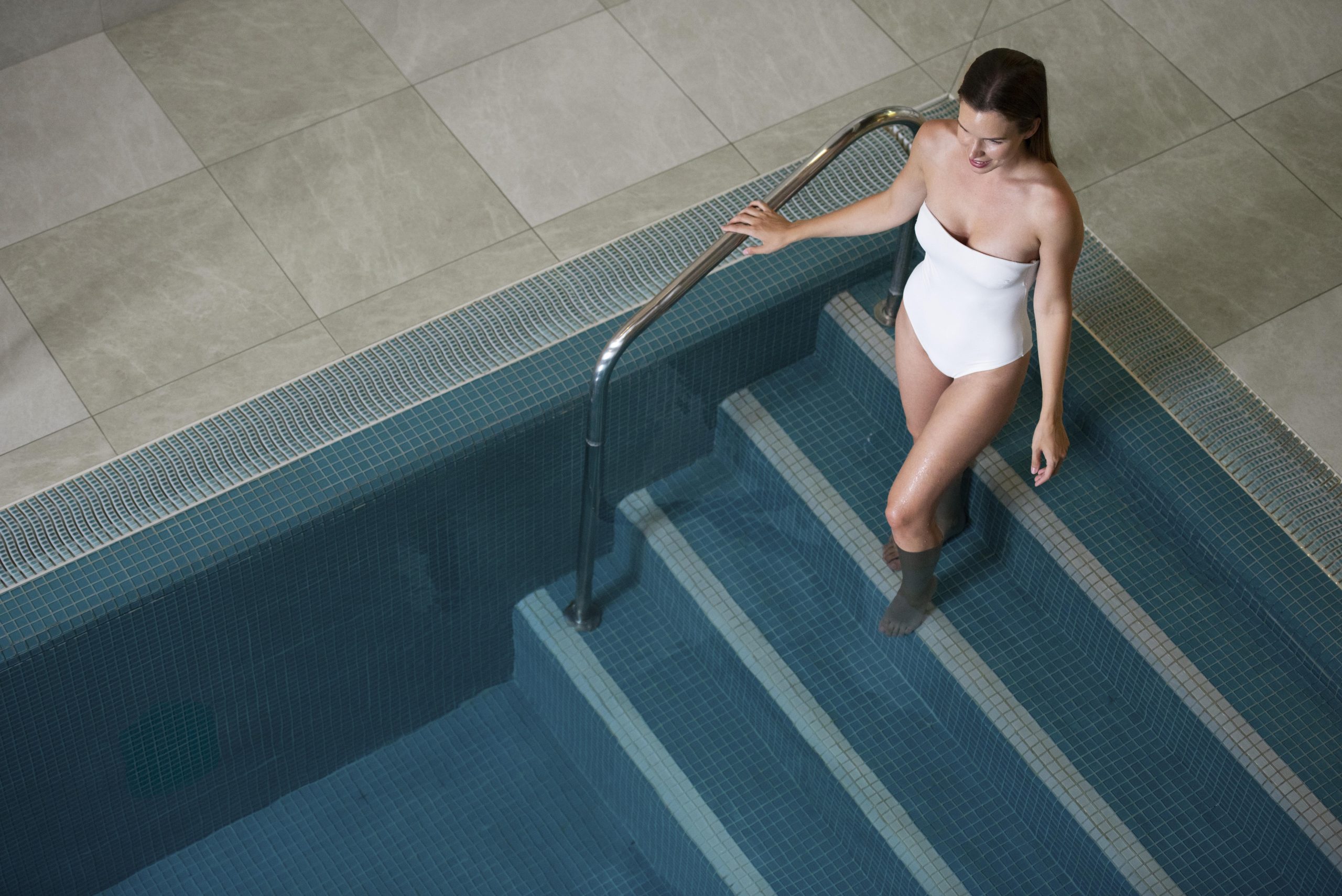
Its design mimics the motion of a standard staircase, which makes it suitable for children, older adults, and people with reduced mobility.
It also aligns with the operational safety requirements that UNI EN 15288-2 sets for public pools. - New builds or renovations with a higher budget. These projects can accommodate a Roman-style or monoblock staircase, built directly into the pool structure using fiberglass, masonry, or steel (positioned above or below the liner, depending on the construction method).
The design echoes classic Greco-Roman style, with wide steps often doubling as sunbathing ledges or spots for hydromassage jets.
This is largely an aesthetic choice that adds perceived value, and it’s popular in hospitality venues, wellness centers, and private villas. However, it demands more pool space and a higher construction budget. - Above-ground residential pools. For this segment, the standard answer is a freestanding, removable ladder made of metal or plastic. It’s affordable and easy to take down at the end of the season.
Because the price point is low, it’s worth double-checking the handrails, non-slip treads, and the maximum load the manufacturer specifies. - Public or hospitality facilities with accessibility obligations. In this case, a ladder alone isn’t enough. It needs to be paired with a lift system, either fixed or mobile, designed for people with motor disabilities.
Installing an electric pool lift must follow the equipment rules on distance from water and permitted voltage set out in CEI 64-8, section 702, which covers rooms containing swimming pools.
In Italy, hospitality venues and public facilities are also required to remove architectural barriers under Law 13/1989, Ministerial Decree 236/89, and Law 104/1992 (Article 23), which ties the issuance and renewal of certain permits to a facility’s actual accessibility.
Materials: Not All Stainless Steel Is Equal
Nearly all quality pool ladders on the market are made from AISI 304 or AISI 316(L) stainless steel, and the difference between the two goes beyond marketing:
- AISI 304 contains chromium and nickel but no molybdenum. It resists corrosion well in general environments, but performs less well when exposed to concentrated chlorides over time.
- AISI 316(L) also contains molybdenum, which meaningfully improves resistance to chloride corrosion. Comparative electrochemical studies show that AISI 316 offers better corrosion resistance than AISI 304 in chlorine-rich environments.
In a chlorinated pool, and even more so in a saltwater pool with electrolysis (where chloride concentration runs structurally higher), AISI 316L is the technically sound choice for ladders, handrails, and any metal components in constant contact with water and saline spray.
AISI 304 can still work for lower-cost accessories in less aggressive environments, but it tends to develop surface rust spots sooner when exposed to concentrated chlorine or salt water.
These differences affect a product’s lifespan far more than any coating or finish does.
Pool-Edge Safety: Why Slip Resistance Is a Must
One last factor worth taking seriously is the surface of the steps and the decking around the ladder.
The most widely used technical reference for barefoot, wet-traffic areas, such as pool decks, showers, and changing rooms, is the German standard DIN 51097.
It rates slip resistance across three classes, based on the incline angle at which a person walking barefoot on a wet surface loses grip: Class A covers 12° to 18°, Class B covers 18° to 24°, and Class C covers anything above 24°.
Class C represents the highest safety level, and it’s generally the recommended choice for pool edges, showers, and areas used by children or older adults.
Sources: UNI, Wbox, Piscine Oggi, disabili.com, ediltecnico.it, RSC Advances, polimi.it, acquavivastore.it, coba.com
Image by magnific