Between persistent myths, a boom in mini-pools and a maze of local municipal ordinances, here is what pool owners risk during these months.
As Italy’s first heatwaves arrive, private swimming pools frequently come under public scrutiny, blamed for worsening water shortages. Yet current technology and existing regulations contradict those assumptions, pointing instead to an increasingly regulated sector governed by rules that run from the European level down to individual municipalities.
A system that conserves water
Despite widespread alarm, the residential swimming pool sector accounts for a very small share of national water consumption, which is dominated for more than 50 percent by agriculture. The reason is straightforward: pool water is not replaced every year. Thanks to closed-circuit filtration systems and chemical treatment, the same water stays in the pool for several seasons. The only real loss is evaporation, which today can be reduced by up to 90 percent through isothermal pool covers.
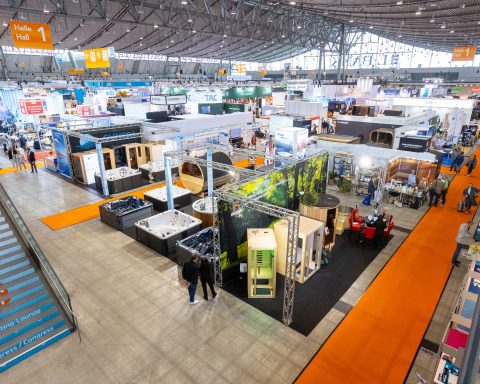
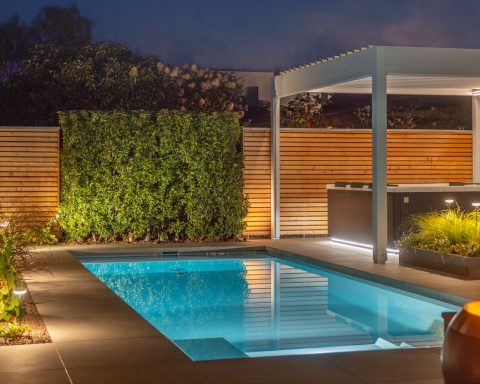
The market is also being driven by mini-pools and outdoor spas, which hold as little as 1,000 to 3,000 litres of water — the equivalent of less than two weeks of showers for an average family.
The European framework: energy efficiency as the industry benchmark
The environmental transition of the swimming pool sector is increasingly guided by European regulation. The key reference standard is UNI EN 17645, a European norm adopted in Italy by UNI, the Italian national standards body, and voluntarily applied by industry professionals since 2023.
This standard introduces, for the first time, a formal environmental efficiency classification for private pools and their components — using an A-to-F scale comparable to the one used for household appliances. The standard encourages manufacturers and installers to optimise three key factors: reducing electricity consumption by filtration pumps, with a push toward variable-speed models; cutting water waste by limiting how often filters need backwashing; and improving heating system efficiency through inverter heat pumps, combined with pool covers to eliminate heat loss and evaporation.
Mayoral restrictions: when the public water supply is off limits
While Europe sets the long-term direction, it is mayors who manage day-to-day emergencies on the ground, using contingency ordinances issued during drought peaks.
A core principle of Italian law — confirmed by river basin management plans — holds that when water resources are scarce, public drinking water must be reserved as a priority for domestic, household and sanitary uses. As a result, municipal summer ordinances almost always include an outright ban on using public water supply networks to fill or top up private swimming pools.
The only legal alternative is to obtain water from licensed private tanker trucks supplying non-potable water. Pool owners must keep the delivery invoice to prove the water was sourced legally if inspected by local authorities.
Enforcement and fines: the penalties for those who break the rules
Compliance with municipal ordinances is monitored by the local police and environmental enforcement units. Those who ignore municipal restrictions face administrative fines that typically range from 100 to 600 euros, depending on the severity of the local regulation.
The situation becomes considerably more serious when private wells are involved. Several Italian regions — including Tuscany, Emilia-Romagna and Puglia — have incorporated directives from the Ministry of the Environment and now require the installation of volumetric meters on private wells.
Extracting groundwater for unauthorised purposes, or failing to submit the required annual consumption report to the regional civil engineering authority, can trigger severe penalties. For hospitality and commercial facilities, fines can reach 25,000 euros, with the additional risk of criminal charges for the unlawful extraction of public water resources.
Image by mrsiraphol on Magnific
Sources: UNI EN 17645:2022; Italy’s Legislative Decree 152/2006; autorizzazionepozzi.it; enea.it